Grimdark Fantasy That Earns Its Darkness
Grimdark has a reputation problem: too much nihilism deployed for shock value, not enough craft to justify the brutality. This collection makes the case for grimdark done right, gathering books where the moral complexity and human cost serve the story rather than simply establishing its credentials.
Recommendation signals: User submission
Why these books work together
# Grimdark Fantasy That Earns Its Darkness
Let's be honest about grimdark for a moment. For every book that uses moral ambiguity and brutal violence to say something true about power, survival, and the compromises we make to stay alive, there are a dozen that mistake shock for substance. Blood on the page is cheap. What's rare, and what this collection is built to celebrate, is grimdark where the darkness has weight, where every severed loyalty and ruined ideal costs something the reader actually feels. These are books that don't flinch, but they also don't look away from the human beings caught in the wreckage. If you've ever wanted to defend the genre to a sceptical friend, these are the titles you hand over.
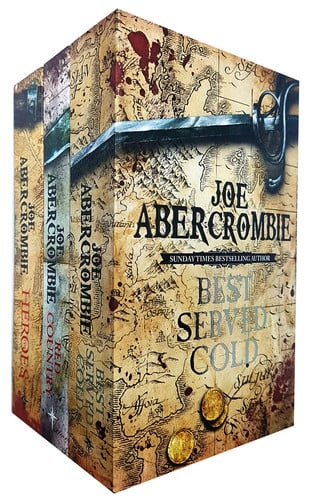
No conversation about doing grimdark right starts anywhere but Joe Abercrombie, and he's represented here with a generous selection because, frankly, he's earned it. If you're new to him, The Blade Itself is where the magic begins, introducing Inquisitor Glokta, a former fencing champion turned torturer whose crippled body and acid wit make him one of fantasy's most unforgettable characters. You can simply dive into The First Law Trilogy as a complete set, watching Abercrombie dismantle every heroic convention you thought you knew, letting conspiracies rise and old scores demand their due. Best Served Cold takes the same world and sharpens it into a revenge tale set in war-torn Styria, where nineteen years of bloodshed have bled the land white and Monza Murcatto's vendetta becomes a meditation on the emptiness of vengeance. Then A Little Hatred pushes that world forward into an age of industry and revolution, proving Abercrombie can make even social upheaval feel personal, violent, and alive. What ties these together is craft: Abercrombie never kills a character or crushes an ideal without making you understand exactly what was lost.
From there, the collection widens its lens. Mark Lawrence's Prince of Thorns gives you Jorg Ancrath, a protagonist who watched his mother and brother die when he was nine and emerged as something genuinely frightening. Lawrence dares you to ride along with a monster, and the brilliance is how he complicates your judgement without ever excusing it. Glen Cook's Chronicles of the Black Company approaches darkness from a different angle entirely, following hard-bitten mercenaries who serve whoever pays them, burying their doubts alongside their dead until a prophecy about the reborn White Rose forces them to reckon with which side they're really on. It's grimdark as grunt's-eye-view, intimate and weary and deeply human.
Richard Morgan brings a harder, faster edge with The Steel Remains, where Ringil, the hero of Gallows Gap, has become a degenerate legend telling tales to credulous travellers until the past yanks him back into violence. Morgan's willingness to centre a queer protagonist in a brutal world was genuinely bracing, and the book's anger feels purposeful rather than performative. And then there's the outlier that anchors the whole collection, Cormac McCarthy's Blood Meridian, which isn't marketed as fantasy at all but haunts every writer on this list. Its depiction of the Glanton gang's savagery across the American West, presided over by the terrifying Judge Holden, is the high-water mark for prose that makes violence mean something philosophical and unbearable. Reading it, you understand what the fantasy writers are reaching toward.
What unites these eight books is a refusal to let cruelty be weightless. Whether it's Glokta's moral exhaustion, Jorg's calculated ruthlessness, or the Judge's cosmic menace, the darkness here always serves a larger purpose, asking what people become when the world strips away their illusions. Start wherever your mood takes you, with Abercrombie if you want wit alongside your bleakness, with Cook if you want weary camaraderie, with McCarthy if you're ready to have your breath taken away. Just come prepared. These books will cost you something, and that's precisely the point. Grimdark done right doesn't leave you numb. It leaves you thinking about the price of survival long after you've closed the cover.